
Project Charter "Inspiration"
Nothing derails an inspiration project faster than a vague brief. See what belongs in a project charter — and what to settle with the sponsor before you start.

Gabriele Bacher
Team Coach
Content
1. Overview
The Project Charter "Inspiration" is the variant of the project charter tailored for the inspirational research of Step 2: Inspire in Phase I. While the general project charter concept applies to any project setup, this version is built for a short, curiosity-driven look into the future — the research that feeds the workshop in which the future vision is developed.
Don't confuse it with the Project Charter "Exploration". That one sets up a six-week research project inside a playground that already exists. Inspirational research comes earlier: there is no Picture of the Future yet and no playground to explore. Producing them is what this research is for. That is also why this charter is the shorter of the two — one page with three fields.
The charter is jointly developed and signed by the Project Sponsor and the Team Manager. It is a commitment on both sides: the sponsor names the strategic question that makes the future worth researching and frees the people to do it; the team commits to bringing back inspiration a vision can be built on, within four weeks.
A good charter goes through several iterations before the project starts. Don't rush this. The Team Coach is involved in shaping it, to make sure the inspiration space fits into four weeks with two to three part-time researchers.
2. Layout & Download
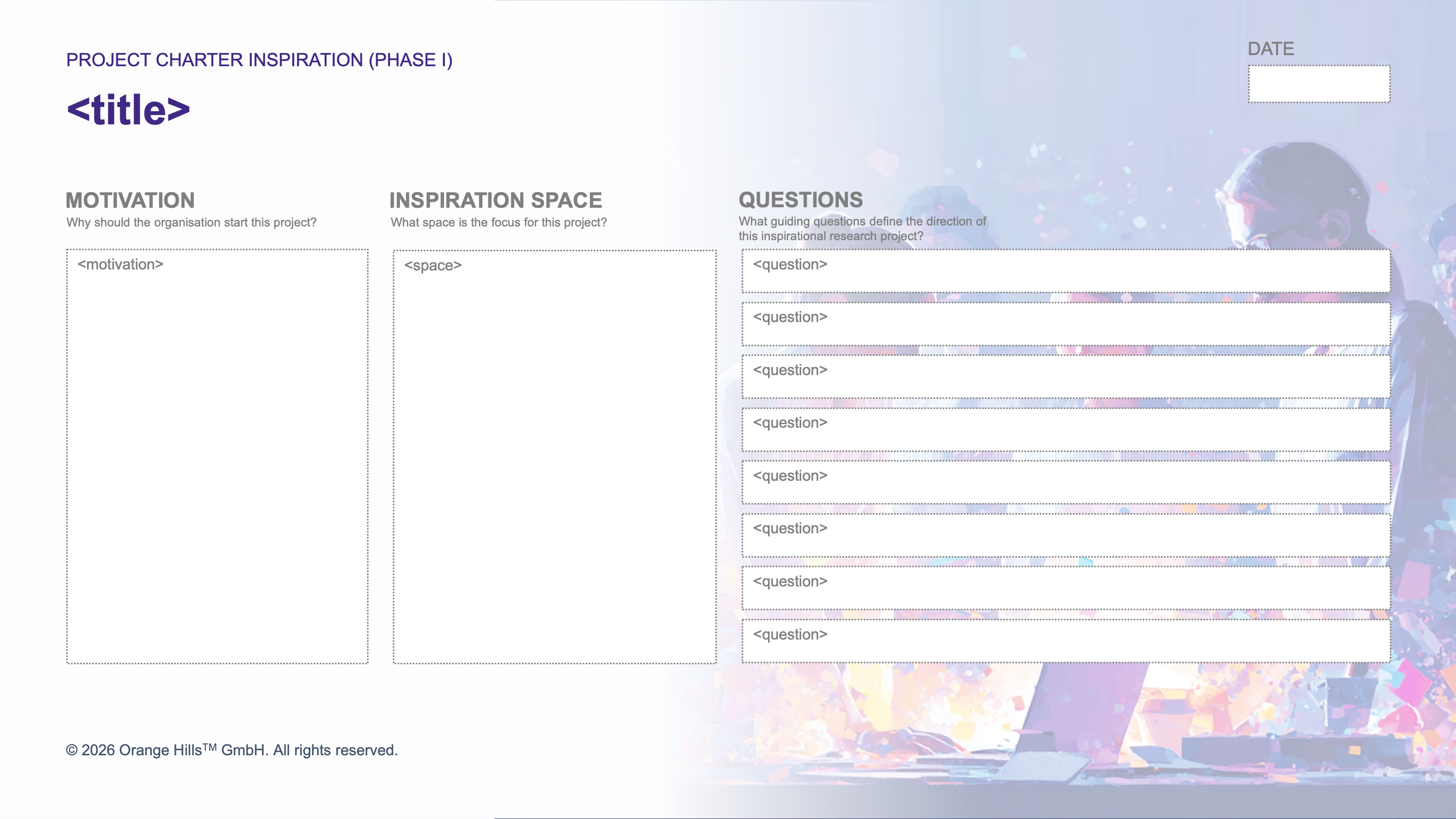
3. Key Elements
The sheet holds a title, a date and three fields. That is deliberate: this early in Phase I there is little worth fixing on paper, and what there is has to be unambiguous:
Motivation: Why should the organisation start this project? Be specific: a strategy cycle that needs a new direction, a technology about to change the rules of the game, a market that has started to move. "Because innovation is important" is not a motivation.
Inspiration space: What space is the focus for this project? It is the counterpart to the playground of later phases — the stretch of future the team is allowed to roam. Cut it from the research categories of Step 2: Inspire: lead customers and users, lead competitors, adjacent industries, new technological capabilities, macro-economic trends and societal trends. Two to three people in four weeks do not cover all six at a depth anybody can use, so name the ones that matter and say what you are leaving out.
Questions: What guiding questions define the direction of this inspirational research project? Guiding questions, not a research plan — the Project Team turns them into concrete tasks at the kick-off. "How will our customers buy in 2032?" belongs here. "Which of these three suppliers should we pick?" does not: that is a question for a later phase and it will produce a market report instead of inspiration.
Note what the sheet does not ask for: the team, the time horizon and the dates. All three still have to be agreed before the project starts — they just live in the project setup rather than on the charter. The next section covers them.
4. How to Write a Strong Charter
Start with the sponsor's own view of the future, not with a list of trends. Ask two questions: what do you believe will be true in five years, and where are you unsure? The second answer is where the research starts.
Watch for the sponsor who already knows the answer. Inspirational research commissioned to confirm a strategy that has already been decided is an expensive rubber stamp. A charter frames the search, never the result.
The eight question slots on the sheet are a ceiling, not a target. Five sharp questions beat eight that overlap, and a sponsor who has to choose between them has already done half the thinking.
Settle the team while the charter is being written. Two to three experts, availability confirmed by the people themselves, not by their manager's goodwill. "Very busy, but I'll try to make it work" is a no.
Fix the date of the Vision Workshop first, then work backwards: four weeks of research between a kick-off and a closing workshop. Inspirational research has a hard deadline by design — it is worth nothing once the vision has been written.
Name the output format and the airtime. Workshop posters per part of the inspiration space, one to two hours to present them. A team that doesn't know how its findings will be used builds a slide deck nobody reads.
Keep in mind
Write the time horizon into the inspiration space — three to six years is the usual frame — because the sheet has no field for it. Everybody nods at "we are looking at the future" in the room, and three weeks later half the team is analysing this year's competitor pricing. A number is the only version of that agreement that survives contact with a search engine.
5. Usage Scenarios
Setting up the inspirational research of Step 2: Inspire with the sponsor
Aligning expectations between sponsor, Team Manager and Team Coach before the research starts
Briefing the research team on the inspiration space, the time horizon and the deadline at the kick-off workshop
Explaining to the rest of the organisation why a team spends four weeks on questions that carry no immediate business case
6. Instructions for Coaches
Don't accept a charter at face value. Your job is to challenge and sharpen it. Two rounds of revision with the sponsor and the Team Manager before the project starts is a realistic minimum.
Ask for the time horizon first. It is not on the sheet, it is the element sponsors get wrong most often, and it decides whether the project delivers inspiration or a market report.
Measure the inspiration space against the people and the weeks. All six research categories, two researchers, four weeks — that charter promises a scan so thin that no vision can be built on it. Cut it down and say openly what you are dropping.
Make sure the sponsor understands what signing means: the researchers are genuinely released for the agreed days, and the findings get their slot in the workshop that develops the Picture of the Future. Research without an audience dies in the file repository.
7. Q & A
Do we really need a charter for four weeks of research?
Yes, and precisely because it is short. A six-week exploration can absorb a wrong turn in week two. Four weeks cannot. One page is what keeps three part-time researchers pointing in the same direction from day one.
The sponsor wants "everything about the future of our industry". What do we do?
Make the trade-off explicit instead of promising everything. Ask which part of Step 3: Imagine the findings have to feed, then cut the inspiration space to what touches it. What doesn't fit is a candidate for a playground later on — write it down rather than argue about it.
How is this charter different from the one for exploration?
By what exists when it is written. Inspirational research runs before there is a picture of the future, so it has no playground to work in and no scope to agree on — it has an inspiration space instead. Exploration runs inside a playground that Phase I has already produced, and its charter asks for scope, resources and milestones as well. Same logic, different starting point.
We found something great that sits outside the inspiration space. Do we drop it?
No. Inspiration is the one kind of research in Business Design where a surprise counts as a result rather than a deviation. Take it to the closing workshop and let the team judge it there. Just don't let it quietly replace the space the charter names — that is how four weeks turn into a collection of interesting links.