
Phase I: Picture of the Future & Strategy
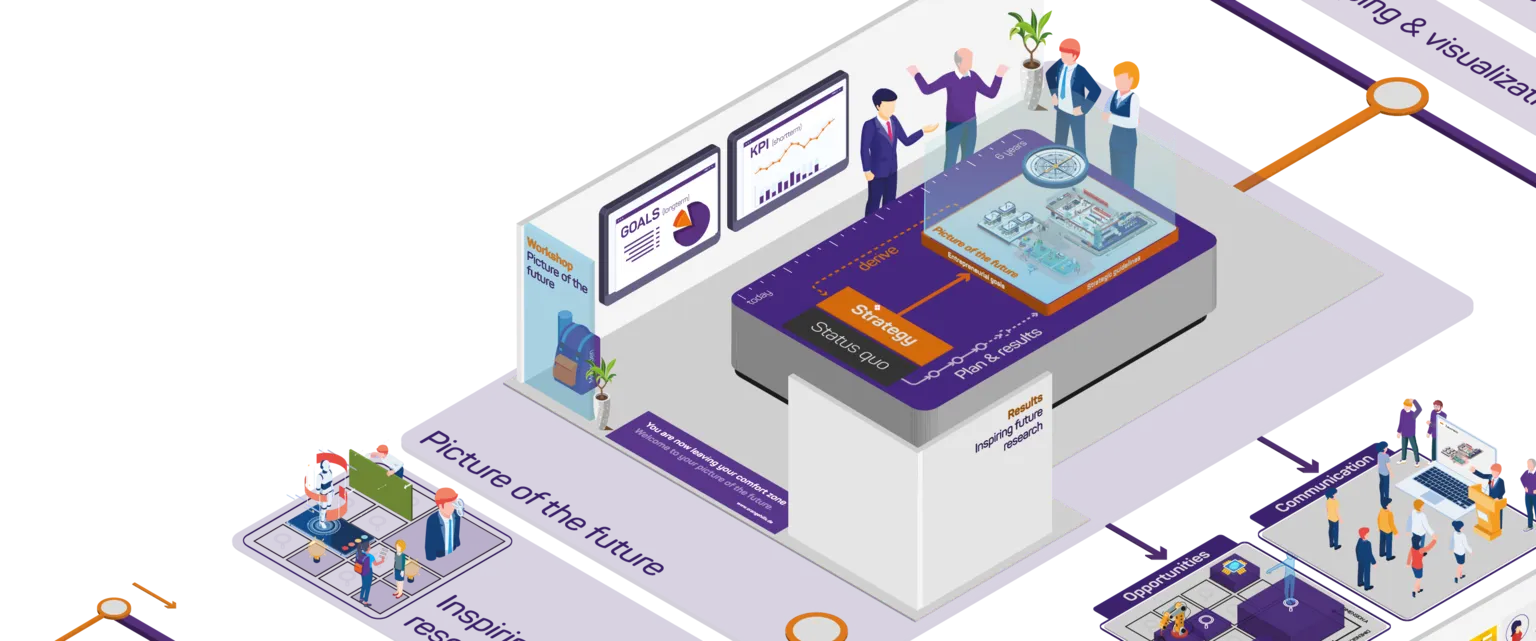
The first phase of the end-to-end innovation process sets the context for all innovation activities. We create a picture of the future and derive the strategy to get there. Let's dive in and see what strategic guidance you need to succeed with innovation.

Bernhard Doll
Business Design Maverick
1. Purpose
Innovation work needs clear, tangible strategic direction. This is especially true when developing new products and Business Models meant to depart from today's core business — it's essential to understand which ideas fit from a strategic perspective and which don't. Many companies have a vision, a strategy and at least some financial goals, haven’t they? The initial reaction of some managers to the question of whether they have a clear vision for the organisation they are accountable for is:
Sure! We want to become the No. 1 in our industry XYZ and increase our gross margin by 3%.
Well, this is neither a Picture of the Future nor a strategy. It is a goal. And by the way, terms such as "purpose", "vision", "mission", "strategy", "goals", "KPIs" etc. are often mixed up and create more confusion than clear guidance. Also buzzwords such as "digitalisation", "sustainability", "customer centricity" are a good starting point but not precise enough that they provide any guidance for innovation activities and management decisions around these activities. And this misconception is prevalent in many companies.
Readings
Check out the explanations of our guiding principle Dream Big. Act Small.
In Business Design, we address this by developing a picture of the future, which is then completed with a Measurement of Success & Progress and an innovation strategy. The first phase of the End-to-End Innovation Process is dedicated exactly to this task. Dream Big, Act Small is our motto. What matters most is that the outcome of this phase helps everyone involved evaluate and prioritise new ideas of varying ambition levels from a strategic standpoint. Room for individual interpretation should be minimised as much as possible, so that all of a company's innovation activities and investment decisions can be aligned around a shared vision.
Keep in mind
Check out our "Innovation Monitor" with a live demo of a Picture of the Future for a company in the manufacturing industry:
Without a picture of the future, for instance, you will have challenges to derive your "playgrounds" and eventually an idea portfolio. You will also get vague decisions at the end of a Phase IV and never 100% commitment for new ideas. You won’t get the best people for a Project Team. Managers will always rely on numbers and business cases to make decisions in the context of innovation. It will be difficult to kill a bad project, because nobody knows what "bad" really means. Nothing is really good, nothing is really bad. And it is even worse for us: You need to have very sharp senses to realise that the missing vision is the reason for all that. Because everyone tells you the opposite ("sure, we have a strategy!").
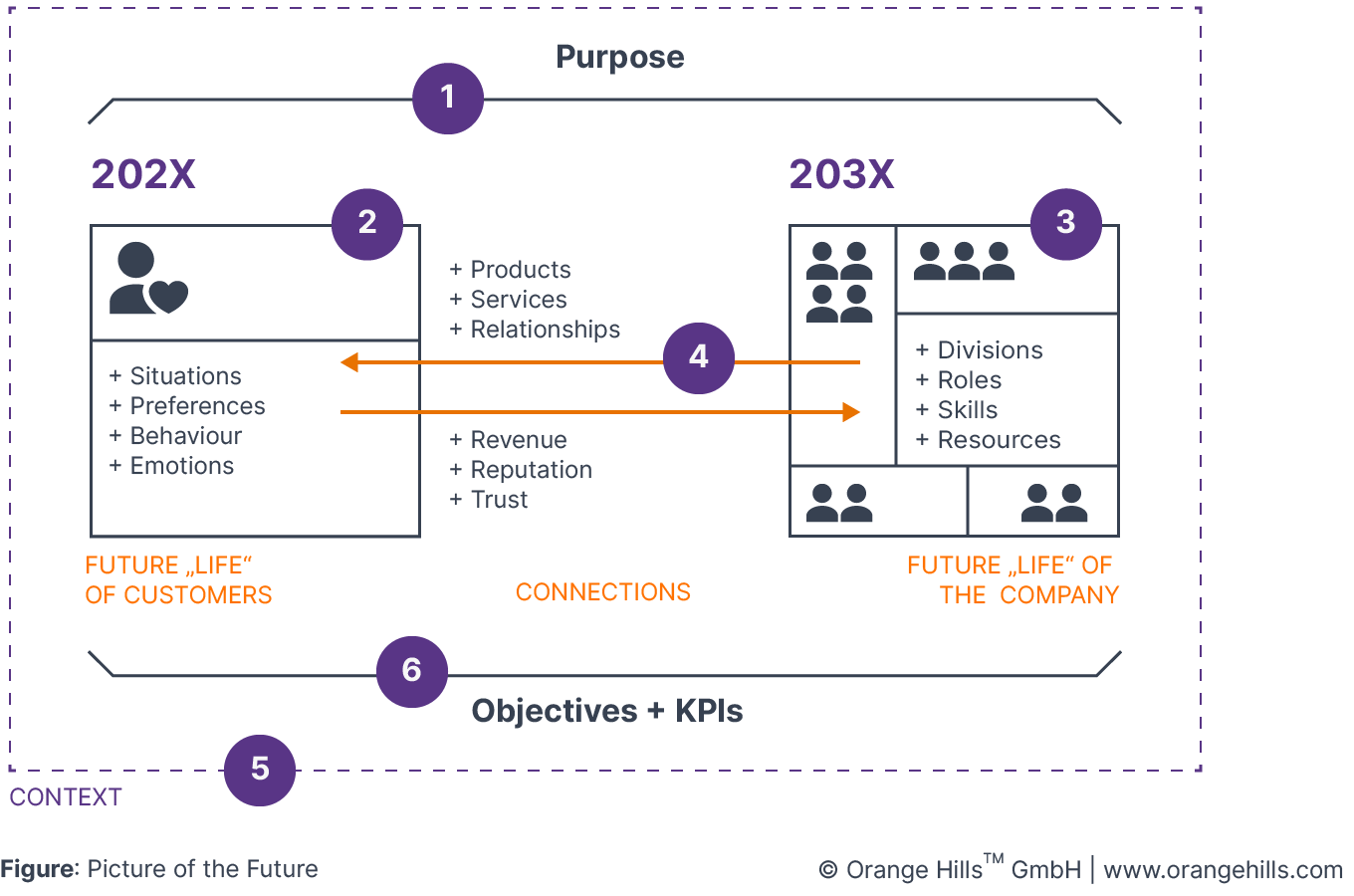
So let's build your dream. A good picture of the future that truly enables innovation consists of six aspects:
The purpose of your organisation: Why will your company still be relevant in the future — to customers, society, employees and partners?
The future life of your customers: What will the lives of your customers look like? Be specific enough to identify implications.
The future life of your organisation: How will your company create value for customers in the future? This is not just a reaction to point 2 — you are designing the future.
The connections between 2 and 3: Future products and services, customer relationships, sales and marketing approaches.
The future context of your organisation: Every company is embedded in a social, technological, economic, environmental and political context. Highlight the aspects most likely to shape your customers and your organisation.
Ways to measure success and progress: Define and measure success (long-term > objectives) and progress (short-term > KPIs).
Here are the questions we love to use as a starting point to build a picture of the future:
Purpose of your organisation:
Why will your organisation still exist in the future?
What are the most relevant playgrounds in the future?
What do you want to be famous for?
Future life of your customers:
"Who do you want your customers to become?" (see book from Michael Schrage)
How will customers live and work in the future?
How many customers are potentially available in key markets?
Future life of your organisation:
Who will be in your organisation and what will they be doing every day?
What will be your core assets and unfair advantage in the future?
What do you need to unlearn to build a sustainable future?
Finding answers to these questions is hard, and the answers will change over time. That's the nature of strategy. But as a leader, you must have answers to steer the organisation, decide and prioritise. Capturing your answers in a visual format (mind map, video, LEGO Serious Play, illustration, Innovation Monitor) can help — but it's not always necessary. Running a few Business Design projects is one of the best ways to find brutally honest answers about where you stand today and where you need to go.
Keep in mind
We don’t need a "perfect" map of the future. The details of the picture will be wrong anyway. But what is the point then? The goal of this exercise is not to precisely predict the future, but to support everyone in an organisation to make big and small decisions today in an aligned manner. This may impact your hiring process. This may impact which ideas will be prioritised. This may impact how Project Sponsors guide new innovation projects.
2. Duration
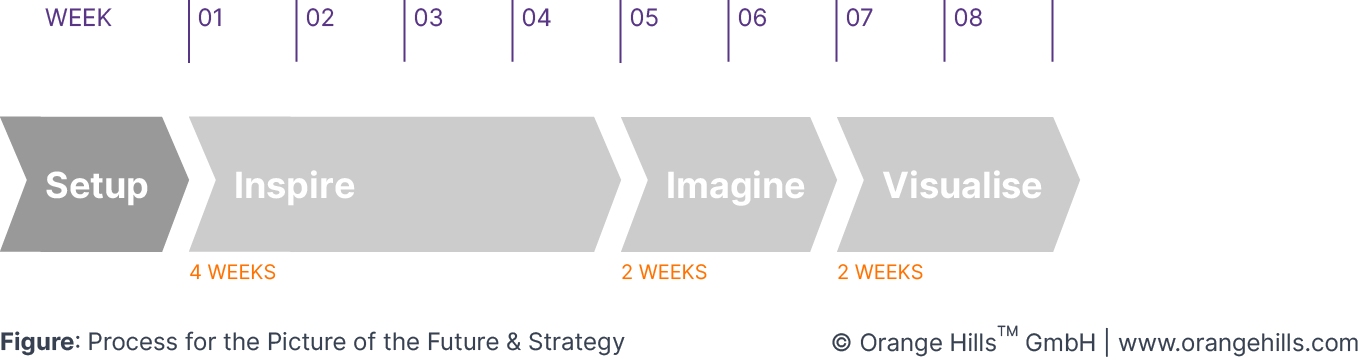
Step 1: Setup: 2 weeks
Optional: Step 2: Inspire: 4 weeks
Step 3: Imagine: 2 weeks
Step 4: Visualise: 2 weeks
3. Key Activities
These are the core activities of this phase:
Step 1: Setup: We get a clear picture of the appetite for change, try to get internal sponsorship and set up a Project Team for the inspirational research as well as the upcoming Vision Workshop.
Step 2: Inspire: Before we answer any strategic question, we start with a preparation phase we call inspirational research. A small team of curious people explores the future today: they talk to (lead) customers and users who do things beyond the mainstream, they interact with trend researchers. They analyse the capabilities of new technologies and try to figure out what future use cases might be conceivable. The goal is to gather inspirational content that helps you design a picture that embraces the future instead of repeating the status quo. This step is optional.
Step 3: Imagine: In this step, a small team of C-level and Innovation Managers meets in a series of workshops. They digest the inspirational content from the previous step and work through a set of strategic questions covering the future "life" of customers, the future of the organisation itself, Measurement of Success & Progress and finally a corresponding innovation strategy. The answers become the brief for a designer, who turns them into a visual Picture of the Future.
Step 4: Visualise: This is usually an iterative feedback process: workshop participants review the picture of the future and refine it through several versions. They also craft a compelling story for audiences inside and outside the company. The last step is documenting both the picture and the story in a format like PowerPoint or Innovation Monitor. Done.
Keep in mind
A Picture of the Future is barely driven by pains and challenges your customers experience today. Your vision should be driven by an entrepreneurial idea what kind of future YOU want to build with your company. Sounds scary? It shouldn’t and, by the way, your picture of the future can be revisited and revised over the years. Be brave!