
Dream Big, Act Small
This article is for advanced Business Designers who want to bring their Business Design projects to a more ambitious level. We consider a tangible and aligned dream — a so-called "Picture of the Future" — one of the most important prerequisites for successful Business Design projects. We want to explain what a "Picture of the Future" looks like and why it matters so much for innovation projects.

Bernhard Doll
Business Design Maverick

Every innovation activity, every innovation project needs guidance and orientation. And this guidance can't come from goals alone, such as:
We want to become the No. 1 in our industry XYZ and increase our gross margin by 3%.
A goal defines success. But it gives you very little guidance here and now: Which ideas are relevant? Which projects should be kicked off, which should stay in the backlog? Goals don't answer questions like how AI might help your organisation improve. The real question is always: What kind of organisation do you want to build? What innovators need is an idea — call it a dream — of what a desired future looks like. Not in every detail, but as an entrepreneurial narrative that makes today's decisions easier, even small ones. Business Design can't work if management has no clear picture of what customers and the organisation should look like in the future. We call such a dream a Picture of the Future.
Why does that matter? If your idea of the future is vague — more a goal or a buzzword ("digitalisation", "sustainability", "AI-driven") than a concrete vision — pretty much everything you do in managing innovation will be difficult. You'll get vague decisions and never 100% commitment to new ideas. You won't attract the best people for your Project Team. Managers will always fall back on numbers and business cases. It will be hard to kill a bad project, because nobody knows what "bad" actually means. Nothing is clearly good, nothing is clearly bad. And here's the tricky part: You need sharp instincts to recognise that the missing "dream" is the root cause of all this. Because everyone will tell you the opposite: "Sure, we have a strategy! We know what we are doing!"
The magic happens when you reverse-engineer everything you do today from your Picture of the Future. We call this path strategy. It includes a growth ambition with goals and KPIs, Playgrounds, a Portfolio of ideas, Financing and Budgets, etc. In many companies, it works the other way around: they analyse their status quo and make plans to improve the existing world incrementally. That is fine for small steps, and you don't need Business Design for it. However, if you have ambitious goals in mind, working backwards from the future to today is the way to go. A plan is not a strategy.
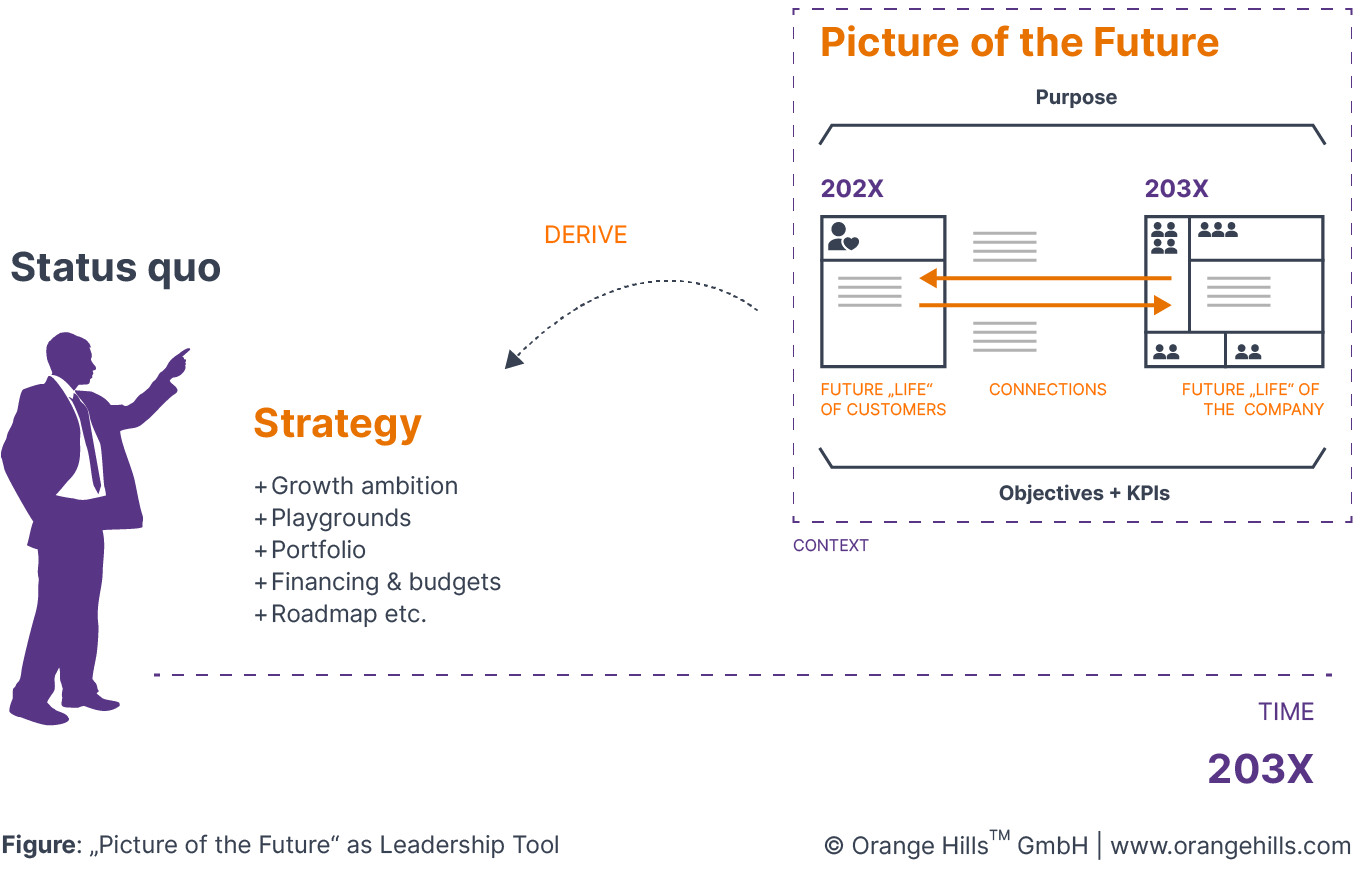
Smart people might say: "How can we predict the future?" That's not the point. It might happen that we end up with a different reality than we had imagined. We don't need a perfect map of the future. The point is that every endeavour around new products, services or Business Models needs one clear direction for everyone in an organisation to follow — to reduce chaos, ambiguity and friction. If we learn along the way that some aspects of our dream are not achievable, we adapt. The goal is not to predict the future precisely, but to help everyone in an organisation make big and small decisions in an aligned way. This impacts your hiring process. It impacts which ideas get prioritised. It impacts how Project Sponsors of Business Design projects guide new innovation projects.
Keep in mind
A picture of the future is not primarily driven by the pains and challenges your customers experience today. Your vision should be driven by an entrepreneurial idea of what kind of future YOU want to build with your company. Sounds scary? It shouldn't be. And by the way — your picture of the future can be revisited and revised over the years. Be brave!
But dreaming big is only one side of the coin. Every dream is built on ideas, on assumptions, on hypotheses that carry significant risks. So we don't implement a big picture of the future 1:1 right away — instead, we break it down into small, digestible elements that we can detail, validate and optimise in individual projects, here and now. This happens in the End-to-End Innovation Process, in the downstream Phase II, Phase III and Phase IV. And it's these phases that make Business Design an agile approach, in which, through short learning cycles, individual elements of a big dream are tested and refined until they hold up against reality. Along the way, we also learn plenty of exciting lessons in practice that help us adapt our Picture of the Future to new realities.
Keep in mind
Consider this quote from sociologist Karl E. Weick in the context of your strategy process: "An organisation can never know what it thinks or wants until it sees what it does."
We think this is true — but a bit too extreme. You can imagine the future (top-down) and always need to consider what your organisation is actually capable of doing (bottom-up).
Check out Phase I of our End-to-End Innovation Process for more details on how we build a picture of the future with a company's management.