
AI Library
AI is a powerful tool for executing Business Design faster and smarter. But it doesn't replace our approach. We need to utilise artificial and human intelligence where each works best and let them complement each other. Here is an ever-growing list of examples of what that means.

Danny Locher
Business Design Coach

Sabine Schoen
Team Coach
Content
1. Introduction
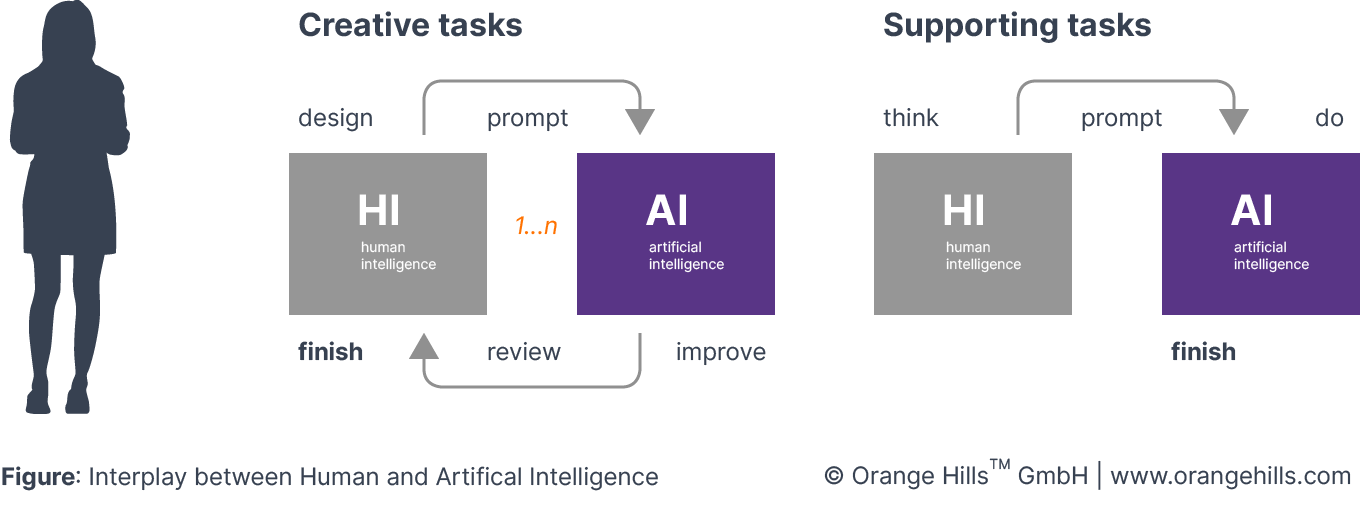
AI strengthens every phase of the End-to-End Innovation Process, often in fundamental ways. Think of it as an interplay between HI (“human intelligence”) and AI (“artificial intelligence”). How the two work together will keep shifting as the technology advances.
The pace of AI progress is stunning, and it’s a huge opportunity for how we shape innovation work. AI now delivers results, on certain tasks, that humans alone could never produce in the same time. The clearest examples: analysing large, messy datasets in customer and market research, and building visual models and prototypes. AI, however, works backwards. It draws on past data that already exists — words, cases, numbers that someone has already written down — and predicts what most plausibly comes next. That makes it excellent at everything repetitive and computationally heavy: summarising, translating, restating, filling in the obvious. But it has no mechanism for going beyond its inputs.
Human thinking runs the other way. You start from a theory — a forward-looking causal idea about how something could work — and that theory tells you which data matter and which experiment to run next. Where the data are thin or point the wrong way, a theory lets you act anyway: Kelvin and LeConte had the evidence on their side when they declared human flight impossible, and the Wright brothers had a causal theory of lift, propulsion and steering, plus a wind tunnel to generate the data nobody had yet. This gap between what you believe and what the data support is not a bug in human cognition; it is where new knowledge comes from.*
AI won’t replace the innovator, the designer, the creative mind who does more than execute tasks efficiently — who convinces people, through passion and conviction, to believe in a new business model, service, or product. AI won’t break down organisational barriers for you. It won’t build high-performing teams or rally them around a shared mission. Success still depends on these human skills. Now and in the future. And current AI tools rely on predictions and probabilities based on large datasets, which is different from human thinking usually influenced by causal logic and reasoning. Nevertheless, we embrace the technological advancements and use them extensively.
Keep in mind
And here is another catch: AI-generated work looks polished, often “perfect”, maybe too polished. That illusion of perfection makes it hard to judge whether the result is actually “good” and makes sense in the context of the innovation endeavour. And it cuts both ways — your competitors are running the same tools and similar prompts. That polish won't be what sets you apart.
In practice, we split AI use into two kinds of tasks.
Creative tasks: Any task that fundamentally shapes the outcome of innovation work stays, first and foremost, with human intelligence. Not because humans always do it better — but because our creative skills, as designers, are what make the real difference. We need to believe in our idea and fight for it. We need to be involved emotionally and that takes “skin in the game”. We stay involved and keep shaping the core of our innovation ourselves.
However, that doesn’t mean we skip AI here. It means we work in three steps:
Step 1: Build a first version using your own creative skills — for example, the core elements of a business model or the storyline for a marketing concept.
Step 2: Use AI tools to improve, expand, or challenge that first version from new angles.
Step 3: Review what AI produced in step 2, then use your creative skills again to integrate what is useful. Your idea can change radically at this point — even should, if the input calls for it. But you stay the designer of your own innovation.
Supporting tasks: Any task that is repetitive or where the past is a fair guide and enables creative work gets full AI support. This is pure efficiency. AI beats human ability at analysing large datasets, pulling out key insights, tracking down missing information, or even building digital click dummies and prototypes. It’s a genuine advantage for instance to generate five landing page variants at the push of a button, each pitching a new business model to a specific audience. But only once a designer has already shaped the story behind that business model — that’s a creative task. Supporting tasks rarely demand deep emotional investment from the designer. Using AI here doesn’t replace the Business Designer. It makes us faster and smarter.
For both types of tasks: Let your AI read this knowledge base and use proven prompts and briefings that deliver results that are highly useful for your work. Let's go.
2. Use Cases
We have developed an ever-growing library of "AI Skills" that take on or simplify important tasks along the End-to-End Innovation Process. These can be called via API on request and used in your own projects. The clever part: each skill draws on our years of experience and accumulated material to improve the results.
AI
How can you get access? We’ve set up an MCP server (= Model Context Protocol) on our side. It lets you connect your preferred AI tool to our API and use our “AI Skills”. All skills use this knowledge base as their methodological reference, and they also draw on real project examples from past work to improve the quality of the output. No project or company-specific information is exposed, though. Just give us a shout if you’re interested in using these skills.
2.1. Phase I
Phase I: Picture of the Future & Strategy
Use Case | Step | API |
Figuring out key trends in certain markets | 2 | Locked |
Defining inspirational research questions | 2 | Locked |
Developing the interview guideline | 2 | Locked |
Transcribing conversations with lead customers and experts | 2 | Locked |
Desk research across the research categories | 2 | Locked |
Long-listing sources: start-ups, research institutes, innovative organisations | 2 | Locked |
Sharpen the guiding principles | 3 | Locked |
Jotting down the coherent story for the designer briefing | 3 | Locked |
2.2. Phase II
Phase II: Playgrounds & Exploration
Use Case | Step | API |
Drafting the project charter "Exploration" | 1 | Locked |
Deriving / challenging research questions for a certain playground | 2 | Locked |
Drafting /challenging a research plan including methods and tasks | 2 | Locked |
Developing / challenging an interview guideline | 2 | Locked |
Transcribing interviews | 2 | Locked |
Structured post-processing of each conversation | 2 | Locked |
Filling the customer & user card from an interview | 2 | Locked |
Competitor identification by desk research | 2 | Locked |
Customer perception research in forums, reviews and ratings | 2 | Locked |
Market sizing arithmetic: TAM top-down, SAM, SOM, and the bottom-up cross-check | 2 | Locked |
Cross-checking findings for contradictions across team members' documentation | 3 | Locked |
Behavioural segmentation | 3 | Locked |
2.3. Phase III
Phase III: Portfolio & Evaluation
Use Case | Step | API |
Formulating the how-might-we questions | 1 | Locked |
Writing up each idea in the idea charter format | 1 | Locked |
Generating new ideas in the given context | 1 | Locked |
Framing the fundamental questions for a deep dive | 2 | Locked |
Desk research on competitors | 2 | Locked |
Transcribing and post-processing customer interviews and expert conversations | 2 | Locked |
Turning deep dive material into the detailed idea description | 2 | Locked |
Challenge a portfolio regarding growth goals | 3 | Locked |
Deriving the project charter for ideas routed to Phase IV or V | 3 | Locked |
2.4. Phase IV
Phase IV: Validation & Refinement
Use Case | Step | API |
Drafting the project charter "Sprint" | 1 | Locked |
Deriving research questions from project charter | 2 | Locked |
Developing the interview guideline | 2 | Locked |
Transcribing interviews | 2 | Locked |
Structured post-processing of each conversation | 2 | Locked |
Consistency-checking of a business model | 3 | Locked |
Building business model variants | 3 | Locked |
Sharpening hypotheses into the house pattern — "we believe that X % of segment will [behaviour] over [timeframe]" | 4 | Locked |
Designing experiments per hypothesis | 4 | Locked |
Building a landing page from a business model | 4 | Locked |
Preparing online ad campaign: keywords, targeting, ad variants, copy | 4 | Locked |
Drafting a decision-making proposal: twelve chapters, all assembled from artefacts that already exist | 5 | Locked |
Drafting a "Decide Wall" for decide workshop | 5 | Locked |
2.5. Phase V
Phase V: Execution & Go-to-Market
Use Case | Step | API |
Assembling first draft of the blueprint from existing material | 1 | Locked |
Writing an executive summary | 1 | Locked |
Financial case mechanics | 1 | Locked |
Consistency check across the whole blueprint | 1 | Locked |
Keep in mind
Build your own "Skills" in Claude — they make prompting far easier. Skills can also be shared across teams, so every team member can use the new capabilities without any hassle.
Looking for support or access to our trained AI skill library? Contact us, we love to share our skills: support@orangehills.com
*Source: Felin & Holweg, "Theory Is All You Need: AI, Human Cognition, and Causal Reasoning", Strategy Science (2024).