
Introduction
Welcome to Business Design! This knowledge base is for doers. For visionary and risk-takers. For people who believe in progress through innovation and new technology. Business Design is an agile approach to innovation and growth management, developed from an entrepreneurial mindset. Whether you are a member of a corporate innovation team or an entrepreneur, a (prospective) team coach or a C-level manager, you will learn what Business Design is and how it can help you reach your innovation ambitions and change the world.

Bernhard Doll
Business Design Maverick
Content
1. Business Design in a Nutshell
Business Design is an agile end-to-end innovation management approach that works best when you are confronted with many uncertainties while building something new. Irrespective of whether you are about to develop a new Business Model, product, service or software application, the Business Design approach guides you through a structured but flexible innovation journey and helps you find your next big opportunity beyond the resources you currently control. "End-to-end" means that Business Design covers the entire journey from your vision of your company all the way to the first revenue you generate from innovation. We consider Business Design as a comprehensive and modern innovation and growth management system.
The Business Design approach consists of five key elements, which support you to become a successful innovator.
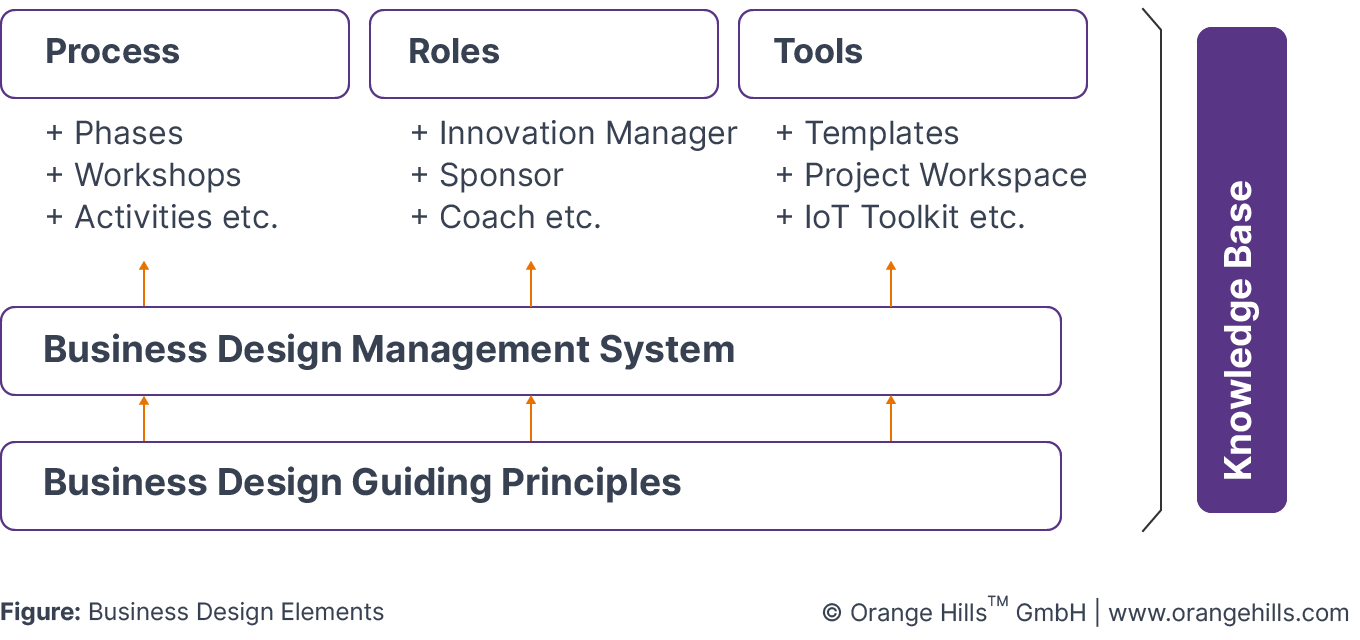
All elements of Business Design are introduced and explained in the knowledge base. Check out these links for further details.
Keep in mind
Combine our knowledge base with your preferred AI tools! Ask your AI tool anything you like and get answers based on our knowledge base as a reference. Create your own digital coach in just a few clicks and have one of the most comprehensive resources on Business Design on the topic at your fingertips. How cool is that?
2. Entering New Territories
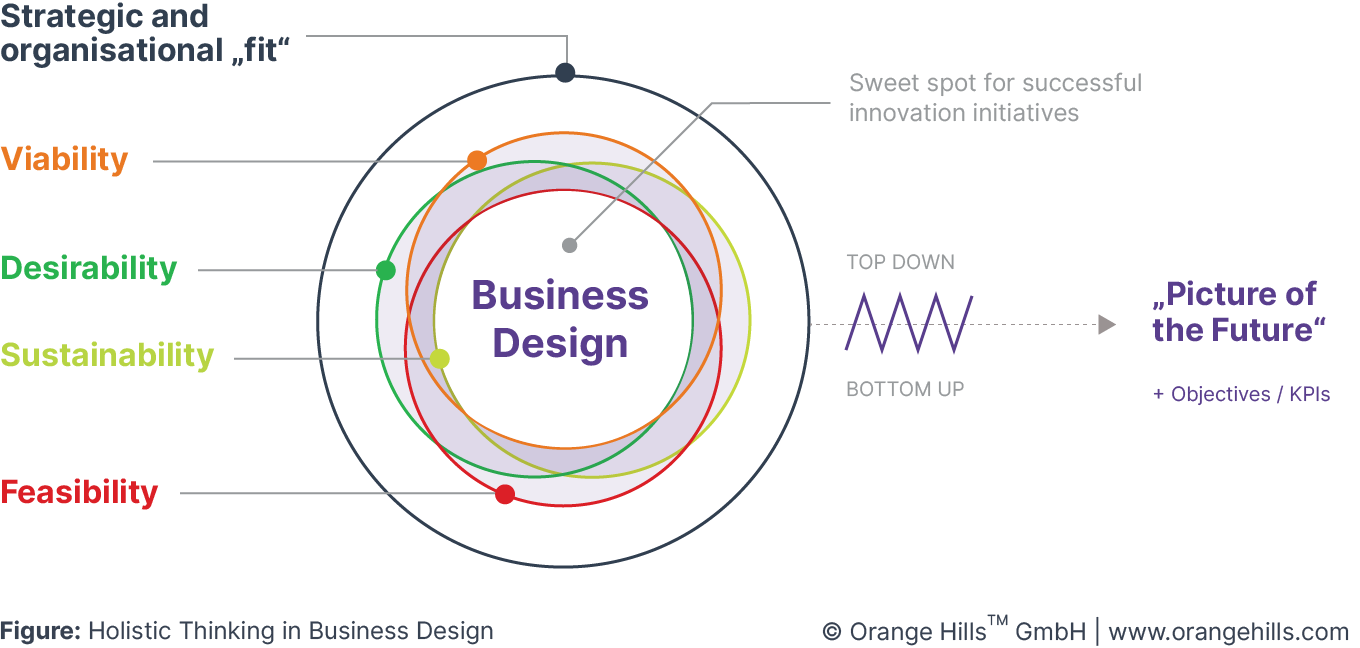
In Business Design, we love to explore new spaces and unveil surprising insights that will ultimately lead to new ideas and innovation. Innovation is not so much about creativity as it is about building ideas based on facts that are not broadly known or widely considered in product and service design. Knowing what others don't and turning this advantage into promising innovation at high speed is what counts. "The future is already here — it's just not very evenly distributed." is what William Gibson wrote a long time ago. And if the "future" is our future, a future we desire, then this statement makes a lot of sense. To fulfil that promise, from day 1 in Business Design, we look at five perspectives to build new business that works:
Strategic and organisational fit: Business Design aims to create innovation that fits well with the strategic vision and envisioned capabilities of a company
Desirability: Business Design aims to create innovation that fits well with today's or future world of customers and users
Viability: Business Design aims to create innovation that helps achieve economic targets
Feasibility: Business Design aims to create innovation that can be engineered and produced under certain economic conditions
Sustainability: Business Design aims to create innovation that doesn't harm the society or life of future generations (by the way, this is not just "blah blah" but an aspect we take very seriously)
3. End-to-End Approach
Business Design is a holistic innovation management approach. Innovation can thrive if a company has a "system" in place that defines and supports the entire journey from vision to revenue — end to end. Very often we see highly fragmented innovation processes with different, sometimes inconsistent, approaches not linked together in a smooth and integrative way. Business Design is different. We have built this system from scratch based on 15 years of experience in innovation management. Business Design is the result of this experience and is now publicly available to everybody who aims to run successful innovation projects and wants to implement a modern innovation management system that works and delivers.
Business Design works alongside an End-to-End Innovation Process consisting of the following phases:
Business Design starts with visionary work and strategy. Without a vision — we call it a Picture of the Future — and a clear strategy, innovation projects can't work. But we don't stop there. As said before, successful innovation requires covering the entire journey, not just some selected steps. These five phases are the answer to any innovation challenge.
4. Systematic Learning
Business Design is based on the idea of an agile learning process to create innovation. What does that mean? We don't believe that successful innovation (which is defined as something "new" determined to generate "growth") can be built in a traditional business development approach in which Project Teams go through a linear process of learning (= market research through customer surveys), planning (= business case modelling), decision-making (= management decision to allocate budget), building (e.g. burning the budget until it is gone) and finally launching the innovation on the market.
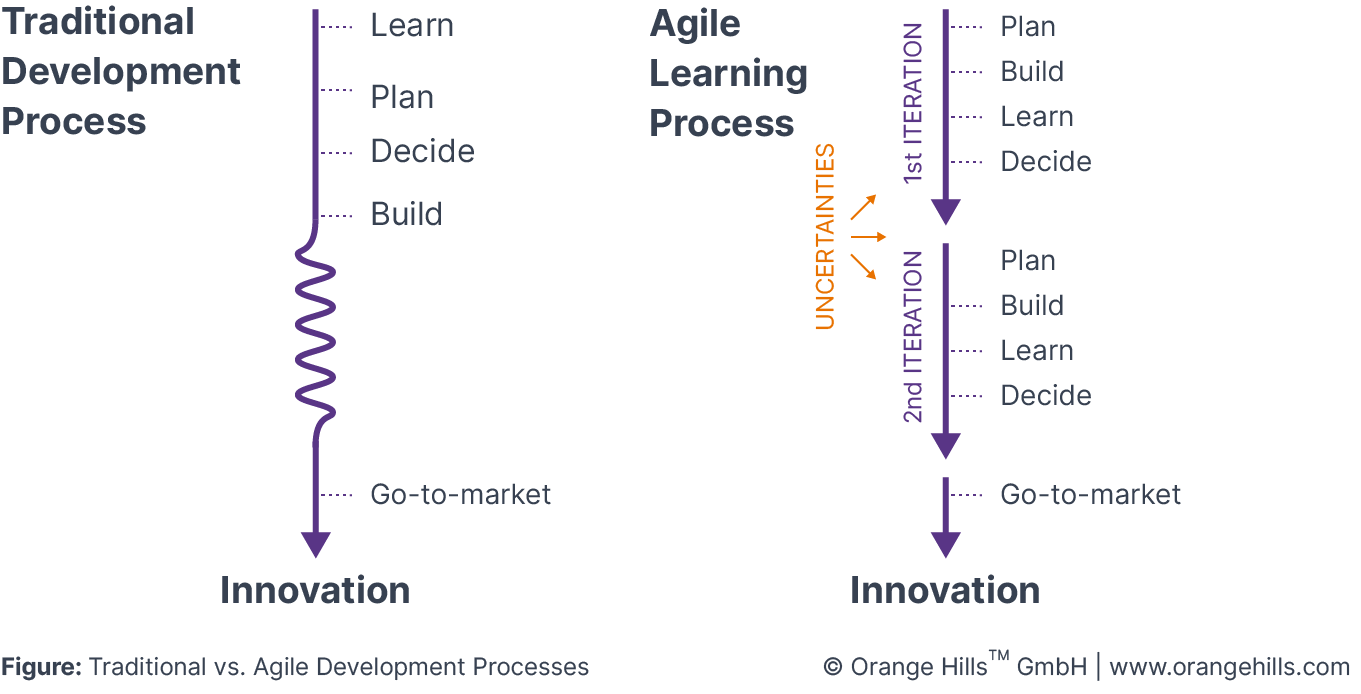
The likelihood is very low, however, that both the Project Team and C-Level Managers are able to anticipate the future and hit the bull's eye with their decisions. The world is fast, customers' behaviour diverse and uncertainties high (by the way, "uncertainties" are not "risks", since risks are controllable and somewhat predictable). This is why Business Design puts the traditional development process upside down and turns it into an agile development and learning process. Through short iterations, a project team enabled and facilitated by an experienced coach quickly makes progress with tangible results and reduces uncertainties through systematic learning. The management (= Project Sponsor) is invited to make decisions not only once but many times throughout the journey to literally steer an innovation project to the market — step by step.
Readings
Are you a C-Level Manager or a member of the Leadership team of your company? Check out our Quick Start for Leaders!
5. When It Fits — and When It Doesn't
Business Design is built for innovation, growth and uncertainty. The higher your growth ambition and the uncertainty, the more you get out of it. If you don't know yet who your customers are, what they would pay for or whether the business behind your idea adds up, this is your approach. It is the wrong tool in three situations. When you already know what to build and only need it built, run a development project — iterating on a settled question costs time and buys nothing. When the open question is purely technical, send an engineer, not a team. And when management wants to decide once and then be left alone until launch, stop before you start: an approach that puts a decision at the end of every phase needs a Project Sponsor who turns up for all of them.
Be honest about this during the setup, not three months in. The approach is strong where the questions are open. It is overhead where they are not.
6. Where to Start
This knowledge base is large. Where you go next depends on the role you are about to take.
You will coach a team: Start with Team Coach and read Hacks for Team Coaches before your first workshop.
You will sponsor a project: Start with Project Sponsor and Measurement of Success & Progress — together they decide whether your project gets steered or merely funded.
You will work in the team: Start with Team Member, then walk through Phase I and follow the process from there.
You want to build the system: Start with Organisational Context and System Playbook.
If none of these fits yet, read the Guiding Principles next. A handful of sentences tell you how we work — and let you decide whether you want to work that way. Then start the journey where every project starts: with a Picture of the Future.
Bon voyage.
Readings
Ries, E.: The Lean Startup, Currency (Amazon)
Schrage, M.: Serious Play, Harvard (Amazon)
Schrage, M.: The Innovator's Hypothesis, MIT (Amazon)
Newport, C.: Deep Work (Amazon)
Osterwalder, A. & Pigneur, Y.: Business Model Generation (Amazon)
Humble, J., Molesky, J. & O'Reilly, B.: Lean Enterprise: How High Performance Organizations Innovate at Scale, O'Reilly (Amazon)
Maurya, A.: Running Lean, O'Reilly (Amazon)
Roam, D.: Blah Blah Blah: What To Do When Words Don't Work, Marshall Cavendish (Amazon)
Kawasaki, G.: The Art of the Start 2.0 (Amazon)