
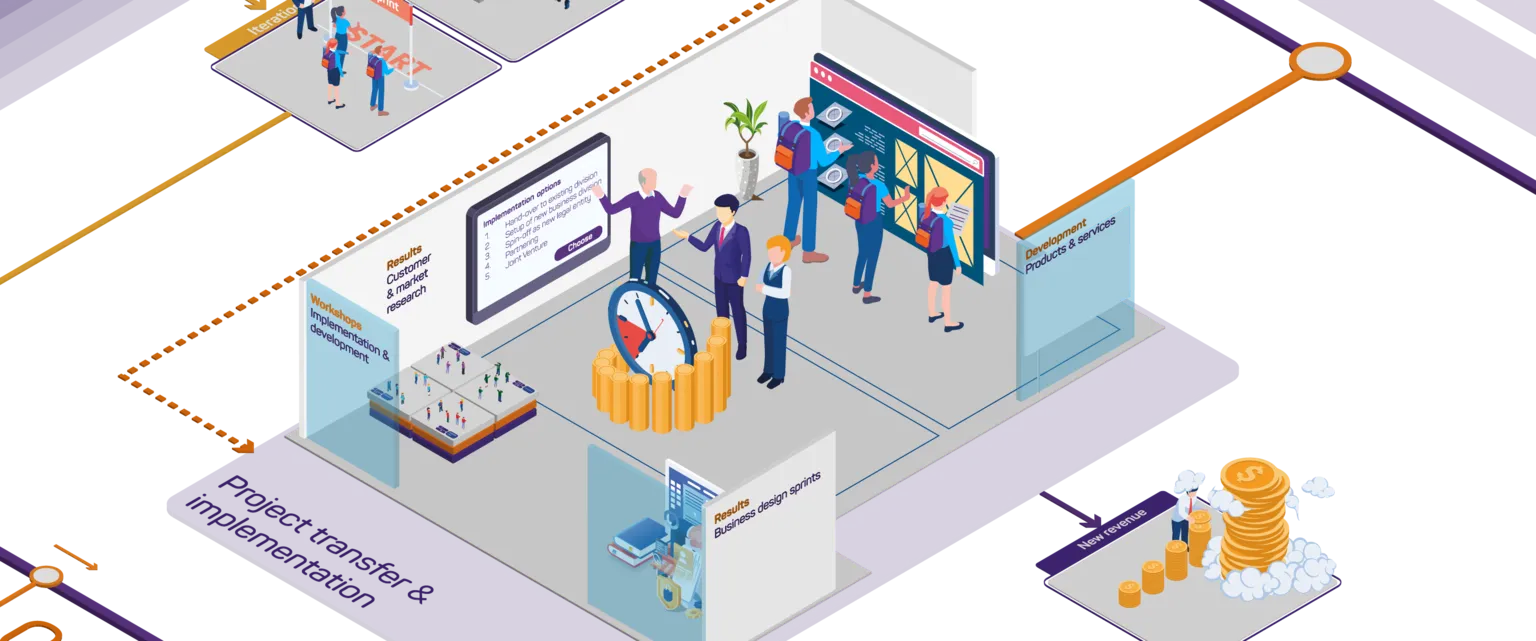
Phase V: Execution & Go-to-Market
The final phase of the end-to-end innovation process consolidates all previous results and prepares market entry. Based on these results, you plan and execute the roll-out of the offer, and prepare the entire operational business. What this means in practice depends on how the new business will be run. More on this in this article.

Bernhard Doll
Business Design Maverick
1. Purpose
Wow. We've reached the final phase of the End-to-End Innovation Process for a new business idea. What does that mean? We're starting a new chapter in the innovation and development journey, under completely different conditions: we now have a promising business idea with a solid Business Model. The success-critical uncertainties are largely resolved, and the support we've had from the organisation so far shows that the business idea fits the company's strategic direction and that bold decisions have been made. There shouldn't be any major surprises left in this phase, even though we can't rule that out completely.
Keep in mind
A Note on Growth
Focus: Pick one primary target group for scaling. Say no to many customers at first, even if you could serve them. Then dig deep into the world of the customers you chose. Don't pretend you understand them already – you probably don't. A focused target group also lets you build a very lean business model, with fewer channels, fewer product variants and fewer exceptions in your processes. That makes your life so much easier! A fast-growing company cannot afford complexity it has created itself.
No compromises: Every little flaw in your business is multiplied many times over when you scale, whether it sits in operations, marketing, customer service or product design. So don't make too many compromises in your business model. Start from scratch if necessary. AI is your friend here: it speeds you up like nothing before.
Automation is key: Scaling needs smooth processes everywhere in your company. New technology helps you automate every process you can. Invest here as much as you can – it pays off ten times over later. But keep your business human where it matters. Don't automate away the moments where your customers want to talk to a person.
Details matter: Scaling doesn't come from one brilliant decision, but from many small ones. The details count everywhere: how you treat your customers, employees and partners, what it feels like to be in your office or on your website, your marketing story and the way your product is designed.
Build your dream – for all the entrepreneurs: Growth can mean many things. Build the company you'd like to work for. Many business models that scale turn into something very different. Your role will change. Your team constellation will change. And you have to live with that – OK?
While pragmatism, speed and learning shaped the way we worked in the previous phases, quality, cost and scalability now take over, as we turn the results so far into a marketable, scalable solution. In many cases, the project setup changes significantly compared to the previous phase, and this depends heavily on how we plan to bring the business to market. There are many options to launch a new business idea. We see four as central:
Handover to one or more business units: At first glance, the simplest path is to hand the new business over to existing business units in this phase, who then take care of the remaining steps to market entry. This step still requires thorough planning and preparation, though, since business units usually need to fit it into their long-running planning cycles.
Setting up a new business unit: If a business idea fits the organisation's traditional business well and depends on the organisation's resources and people, but doesn't quite fit the logic of the existing business units, setting up a new business unit is always an option.
Founding a start-up: Especially when the business idea needs a radically different way of working and entrepreneurial drive to succeed in the market, founding a new organisation for it is a good fit. This usually means looking for new talent in the job market and complementing it with selected experts from the existing organisation. What matters here is keeping dependencies on the parent organisation manageable, so the start-up can act relatively independently.
Partnerships: For further market launch, we look for partners to work with — in the form of a joint venture or another type of partnership. This path is especially attractive when the existing organisation lacks resources or capabilities that are central to developing the business further and bringing it to market. Venture clienting can also be an option here, instead of developing the solution themselves.
Depending on the option chosen, we now need to plan the next steps. We recommend producing a New Business Blueprint for this. It brings together the results from Phase I to Phase IV on one hand, and plans the remaining steps to market entry on the other.
Typical steps in this phase include:
Product development: For physical products or software, we now design and build the actual offer to the usual quality standards.
Marketing and sales preparation: To sell a new offer, we typically need to plan marketing campaigns, change sales processes, and adapt internal software systems and incentive systems for sales staff.
Building operational units: New business ideas often need new resources that first have to be procured and integrated into operations. This includes, for example, new production lines, warehousing, logistics and customer service.
Certifications: Some products and services need to successfully complete certification processes before they can be offered on the market (e.g. CE marking). Organisational processes are sometimes subject to state-regulated quality requirements too (e.g. ISO 9001).
Keep in mind
Responsibilities are what make this phase interesting. They usually shift between Phase IV and Phase V, which can create enormous friction within the organisation. Conflicts of interest, conflicts over competencies, personal vanities, misunderstood roles and other issues can cause delays — and still put the success of the innovation initiative at risk.
2. Duration
Between three and 24 months (depending on the complexity of the business)
3. Key Activities
These are the core activities of this phase:
Crafting of the New Business Blueprint: We describe all the results from the previous phases of the End-to-End Innovation Process in detail, together with the go-to-market plan that complements them. The market-launch options described earlier play a central role here.
Decision on next steps: Based on the new business blueprint, C-Level Management usually makes the final decision on whether to implement the plan we've worked out — or not.
Preparation tasks for go-to-market: Implementation can then begin — from product development to marketing and sales preparation. Many new experts join the effort at this point, which makes this phase particularly challenging.
Launch: The actual launch is usually the easiest step in this phase. All the preparation comes to an end, and day-to-day operations can start. We've made it! But the final whistle is also the kick-off for the next round. Reality will show which changes to the business model are still needed and how we achieve the growth we're aiming for. And we can tackle these changes again using the Business Design approach.
4. Participants
Experts from existing business units (e.g. engineering, procurement, sales, legal)
New talents
New partners (e.g. joint venture partners, start-ups)
External investors
Certification bodies (e.g. DEKRA, TÜV)