
Customer & User Card
Customer & user cards are a great way to present the results of your field work visually. Have a look at how we use them and why they differ from personas.

Gabriele Bacher
Team Coach
1. Overview
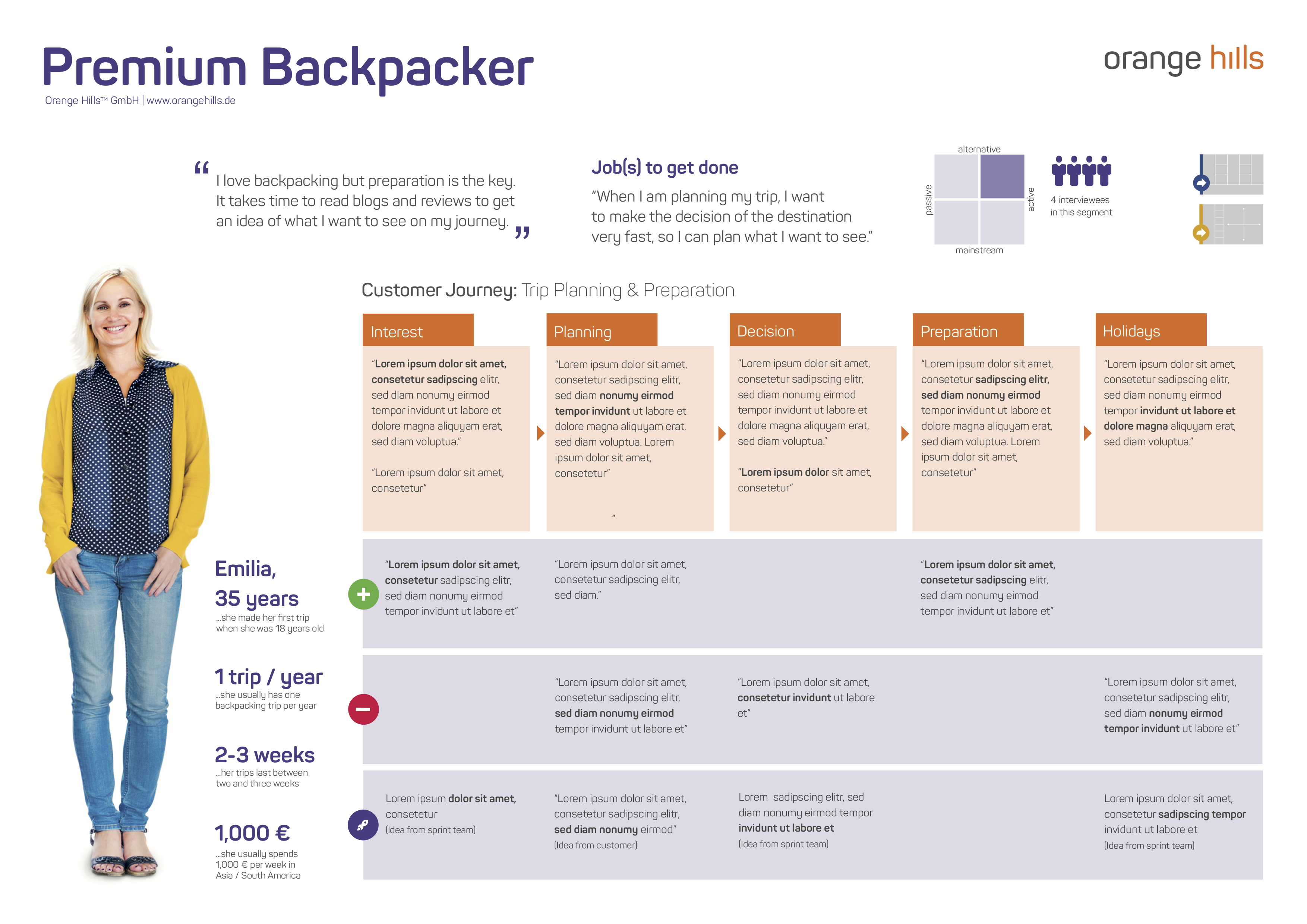
A customer & user card is a one-page profile of one real customer or user you met in your research, chosen to represent a target group. We use them to summarise results from Customer & User Interview and pick one or two "real" customers who represent their Target Groups and present them by using a customer card including no less than:
Key statement
Job(s) to get done statement
Reference to the represented target groups
Relevant(!) demographics
Picture of the person (if possible)
Discussed / observed / experienced customer journey
Positive and negative emotions during that journey
Ideas from the person or the interviewer based on the journey
Based on the type, dimension and results of your Exploring Customers research, you may extend the customer card:
Picture story of a certain process
Pictures of relevant locations like a room, garden, office space, etc.
Pictures of relevant furniture, tools, software, etc.
Other discussed / observed / experienced customer journeys
Contradictions within one target group can be outlined by adding a box "What others said"
2. Example
3. Usage Scenarios
Present results from your Exploring Customers research to your team and other stakeholders
4. Instructions for Coaches
The most important part of customer & user cards is direct quotes. On the one hand, they show that our persona is a real person, and on the other hand, they really help your team to understand the person even though they've never seen them before.
Encourage your team to take a lot of pictures during Exploring Customers with the consent of the interviewed / observed person. Real pictures are always better than stock images. But stock images are better than no images.