
Exploring Competitors
This article shows you how to explore competitors through the eyes of your customers, so that you can find your sweet spot later on. It introduces the perspective to take and the tools that support the analysis.

Gabriele Bacher
Team Coach

Sabine Schoen
Team Coach
Content
1. Purpose
Exploring competitors is a core activity of every exploration, and it goes hand in hand with Exploring Customers. Your starting point is your Target Groups matrix: who else currently helps your target groups to get their job done? Think of the milkshake that competes with a banana rather than with other milkshakes. With that question in mind, explore competitors through the eyes of your customers — not through the categories of your own industry.
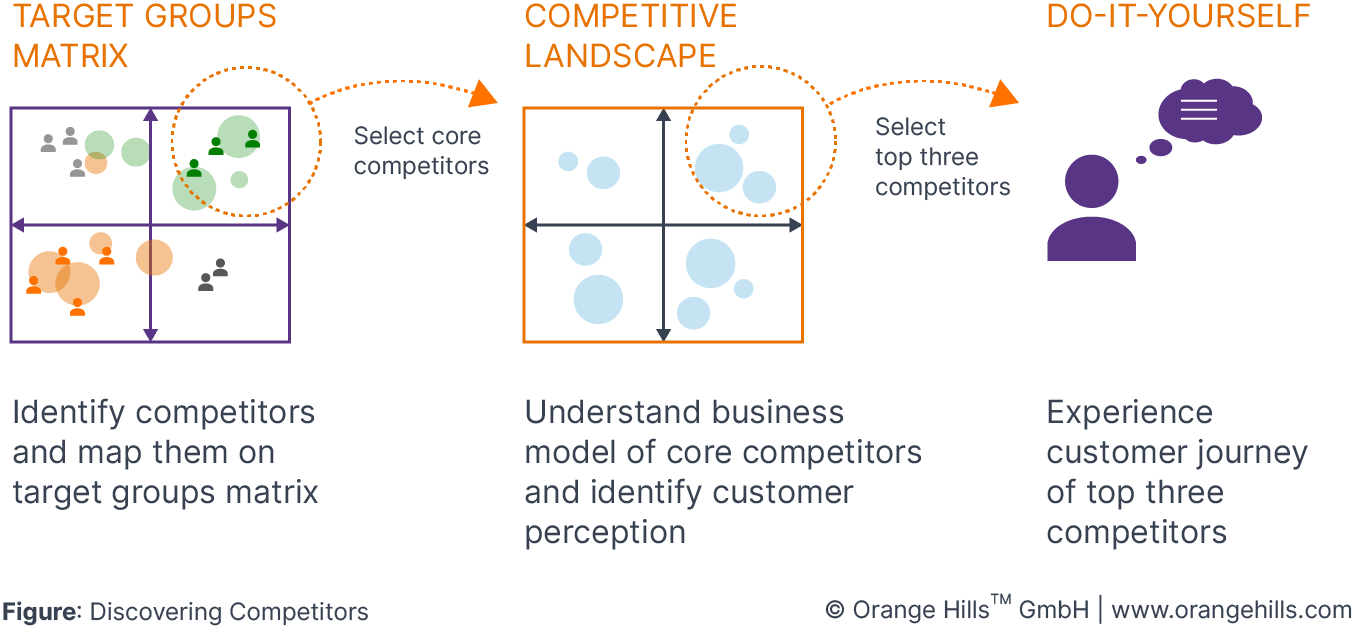
Start with desk research to identify the relevant competitors and map them onto your Target Groups matrix. Depending on the segment you focus on, you get to know the core competitors within it. The Competitive Landscape analysis lets you compare the competing factors in that segment. Then dig for more detailed insights by immersing yourself in the competitive landscape from the customers' point of view, for example with DIY activities: order and use the products of your top three competitors. What you find fuels the Ideation Workshop and, later on, the discussion about the right positioning for your new market offerings and the Business Model that supports it.
Two perspectives matter for every competitor you research. First, understand their business model: the target groups they address, the brand and message they use to do so, and the channels they picked to reach customers and keep the relationship alive. Look at their offerings and the core value they create, and at their pricing and profit formula — annual financial statements are a good source. Finally, work out their unfair advantage: the "magic factor" that makes them successful on the market.
Second, identify customer perception. A business model on paper tells you little about how customers experience it. What do customers and users say about the offerings, the pricing, the service? Forums, reviews and ratings are good sources. Do those competitors get the customers' jobs done properly? Combine what you find with the insights from your Exploring Customers activities.
How much of this you get done depends on the scope of your exploration project (see Exploring Playgrounds). With a scanning scope, answer the first question only: who gets your target groups' job done today, and roughly where do they sit in the matrix? Both perspectives for every relevant competitor, plus DIY activities with the top three, is deep-dive work. Say which of the two you did when you present the results — a positioning built on websites alone is worth less than one built on what customers actually experience, and the difference should be visible.
Keep in mind
In an early exploration, you look at competitors from a broader perspective than you will later, once your level of knowledge has grown. That is quite normal. Just make sure you dig deep when analysing your competitors, to generate surprising and relevant insights. A list of 100 potential competitors is not the kind of information that helps anyone to find a sweet spot.
Keep in mind
It is also fun to research your strongest competitor and ask yourself what you can do better than they do. Be honest with yourself!
The results feed back into your Target Groups matrix and into the segment discussion you start in the Review Workshop. How big those segments are, and what customers spend in them, is covered in Exploring Markets.