
Step 1: Setup
1. Purpose
Before diving into a playground, align expectations with your Project Sponsor, Team Manager, and Team Coach within the Setup Phase. Talking for hours about why this playground matters and how best to explore it is easy — writing it down in three clear sentences is much harder. Use the Project Charter "Exploration" to sharpen a common understanding including:
Motivation
Playground
Scope
Questions
Resources & Stakeholders
Schedule
Two important decisions belong in this phase and are part of the project charter: the focus of the playground, which tells you which research areas the team digs into, and the scope of the exploration project, which tells you how broad or how deep it goes. Both are settled before the Kick-off Workshop, and both go into the charter. The three scopes to choose from — scanning, T-shaped and deep-dive — are described in Exploring Playgrounds.
2. Key Activities
Secure sponsor backing: Every Business Design project needs legitimacy and resources behind it, and that starts with a Project Sponsor. Look for someone internally with real standing in the company and a genuine interest in the project. Pick a sponsor who fits the focus of the playground: for a market-driven playground, someone from sales or marketing; for a technological one, the person responsible for development.
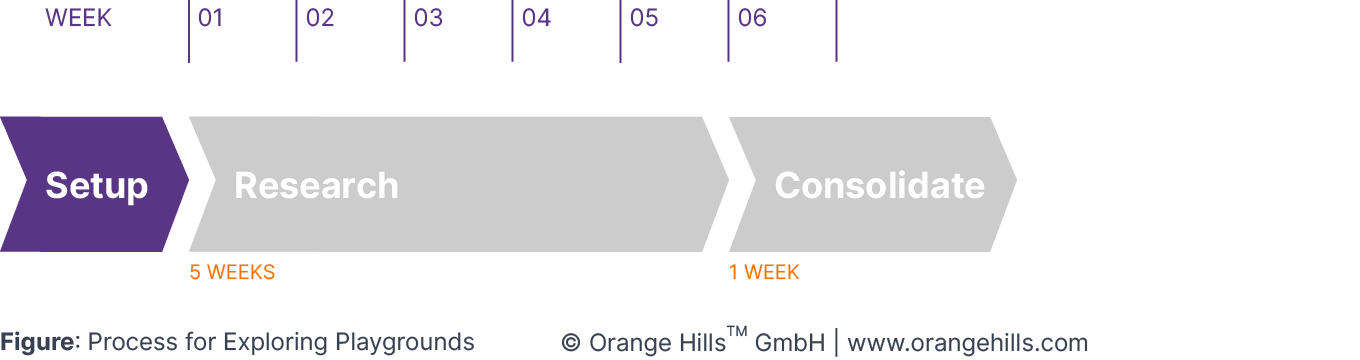
Align expectations: Work through the Project Charter "Exploration" together with your sponsor: pin down the exploration focus, decide how broad or deep the project should go, agree on milestones, and take the time to check how committed the sponsor really is to the project. Six weeks are fixed, so be explicit that breadth is paid for with depth.
Build a curious team: A mix of perspectives helps you get a more holistic view of your project focus. Aim for Team Members with different backgrounds and seniority levels, and match them to the focus of the playground and the scope of the exploration project: a market-driven playground needs people close to customers, a technological needs people close to development, and a deep-dive needs people who can spend real time in the field. Ask your sponsor for input on the team constellation, and make sure the people you choose bring the right expertise and can dedicate enough time over the coming weeks.
Prepare kick-off workshop: Get-to-know calls with the Team Manager and each Team Member give you a feel for the team before everyone sits in one room. Use them to collect what people already know about the playground, and to prepare the groundwork the research will need: possible interviewees, experts to approach, and how to get hold of the data, internally or externally. Then prepare everything else a successful Kick-off Workshop needs.
3. Formats
"Get-to-know" calls with Team Manager and each Team Member
Preparation of the Kick-off Workshop
4. Tools & Materials
5. Participants
6. Q&A
What is a good research frame? You cannot explore the whole world — all (potential) customers, markets, competitors, technologies — in one project. It's tempting to try, but that's exactly the trap. A good research frame starts by going back to the playground: the boundaries you already agreed on for where your project is allowed to look.
Frame your exploration so it's realistic — pick one of the three scopes in Exploring Playgrounds and narrow the frame down to what your team can actually cover in the time you have.
What is a suitable team for an exploration project? We usually build project teams of three or four members. All members should have expertise in the project focus, with diverse backgrounds ranging from sales and product management to strategy and technology. Every team member should have at least 1 to 2 days a week available over the 6 weeks (see Project Charter "Exploration").