
Exploring Playgrounds
In many cases, the picture of the future contains playgrounds that the organisation still knows little about. When that is the case, it pays off to explore the playground in more depth beforehand, as preparation for developing ideas. Learn more about what kind of insights we're looking for and how we generate them.

Gabriele Bacher
Team Coach

Sabine Schoen
Team Coach
1. Purpose
Successful innovation projects rely on fresh and surprising insights from research. Once you decide to explore a playground when uncertainty is high, you set up a team for that playground and start an exploration project. Every exploration project has a focus, set by the uncertainty you identified. Examples are:
Technological Playgrounds where the focus is on using new technologies — whether that's new digitalisation opportunities, new materials with better properties, new sources of energy supply, and so on.
Organisational Playgrounds where you focus on understanding your own organisation's structures and processes better, aimed at building a high-performing value chain for the future.
Market-driven Playgrounds to better understand existing and new customers, users, and competitors who stay — or become — important for your business going forward.
It's important to be clear about it because it calls for different experts on your Project Team and a different research approach. The project team then digs into various research areas based on the focus of the playground.
The focus is one half of that decision, the scope is the other. The focus tells you which research areas the team digs into. The scope tells you how broad or how deep the project goes. Six weeks are fixed, so breadth is paid for with depth. Decide both in Step 1: Setup, before the Kick-off Workshop, and write them into the Project Charter "Exploration". Three scopes cover almost every exploration project:
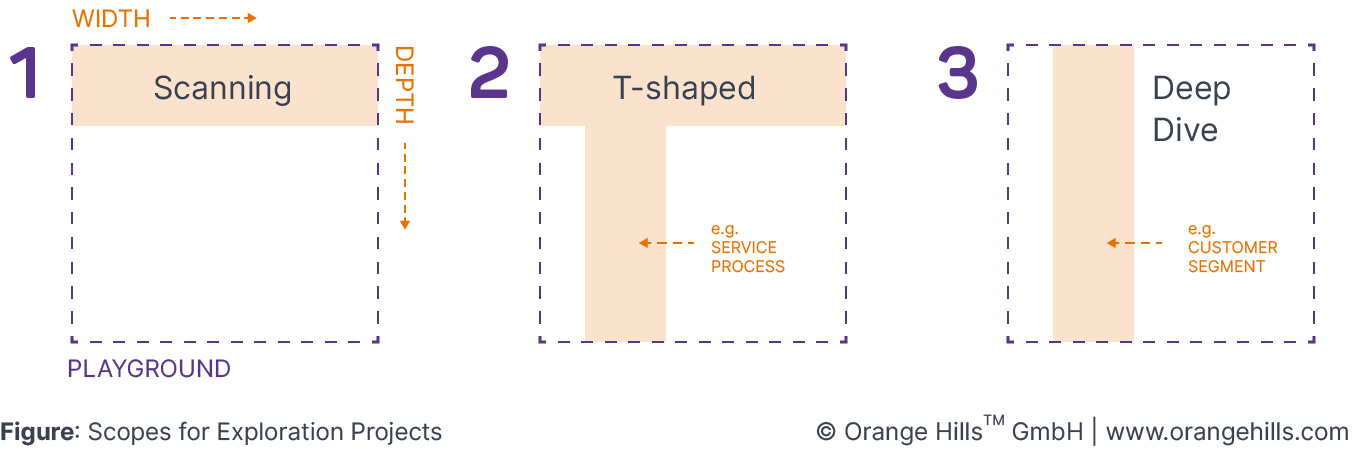
Scanning: The team touches several research areas — mostly desk research, a few customer or user interviews, some expert talks. Pick this when the playground itself is still fuzzy. Be aware that a scanning exploration gives you no real field depth: surprising insights are harder to come by when nobody goes out for long.
T-shaped: One research area in depth, with real field work, plus two or three areas touched with a few desk research questions. Pick this when the playground is set and one area carries most of the uncertainty.
Deep Dive: One research area, worked through properly. Examples are a customer study with 15 interviews as described in Exploring Customers. Or a market analysis as described in Exploring Competitors and Exploring Markets. Or a technology research that ends in a solid technology assessment. A deep dive covers one area and not two.
2. Duration
2 to 3 weeks setup + 6 weeks exploration
3. Key Activities
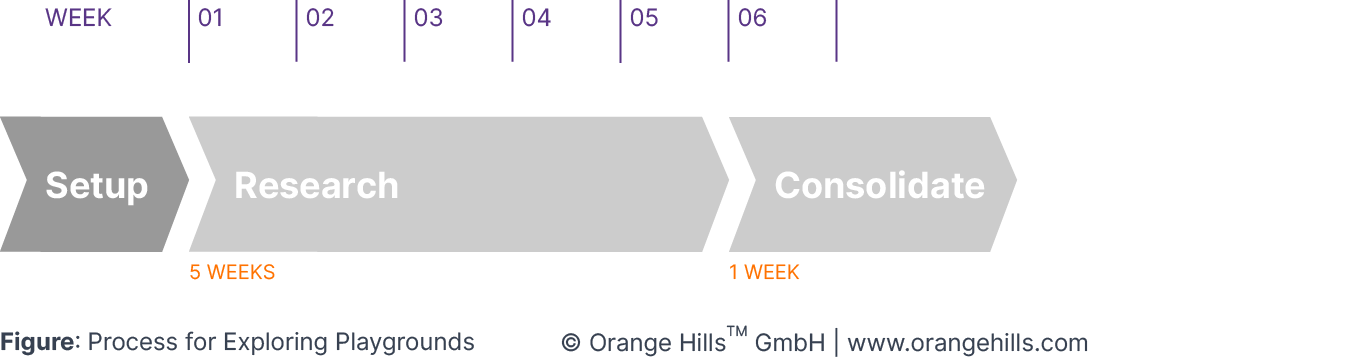
Step 1: Setup: Secure a sponsor, sharpen the research frame (focus and scope) in the Project Charter "Exploration", and assemble a Project Team whose expertise matches the focus of the playground and the scope of the exploration project. Depending on focus and scope, you can already prepare the ground: e.g. identify suitable interviewees and experts, and clarify how you will get hold of the data you need, internally or externally.
Step 2: Research: The Project Team starts with the Kick-off Workshop to define the research questions, develop suitable methods for them, and distribute the tasks for conducting the research. Halfway through, a Review Workshop checks whether the findings are surprising enough and whether the frame still holds.
Step 3: Consolidate: Each research area is documented and reviewed, and the findings come together in the Consolidation Workshop. The result of this step is documented knowledge that can be used and digested in an Ideation Workshop or fresh ideas that can be directly added to the Portfolio.