
Exploring Questions
After identifying open questions in the design workshop (or optionally the validate workshop), you're ready to find answers through experiments. This article describes the key activities, introduces helpful tools and gives examples.

Gabriele Bacher
Team Coach
Content
1. Purpose
In early iterations of a Business Design project, your knowledge of your business model is usually still low. You first need to spend time understanding your innovation context (exploration mode), before you can formulate hypotheses you can test (validation mode). You'll notice the difference in the Design Workshop (or optionally the Validate Workshop) when you formulate open questions instead of specific hypotheses. Let's look at an example: imagine you're not sure whether the features your new networking platform should offer are the right ones. Since this is such an important question, you probably spend some time exploring your core features together with potential users first. Once you're clear about the core features your platform offers, you can test desirability — using sales pitches, for example.
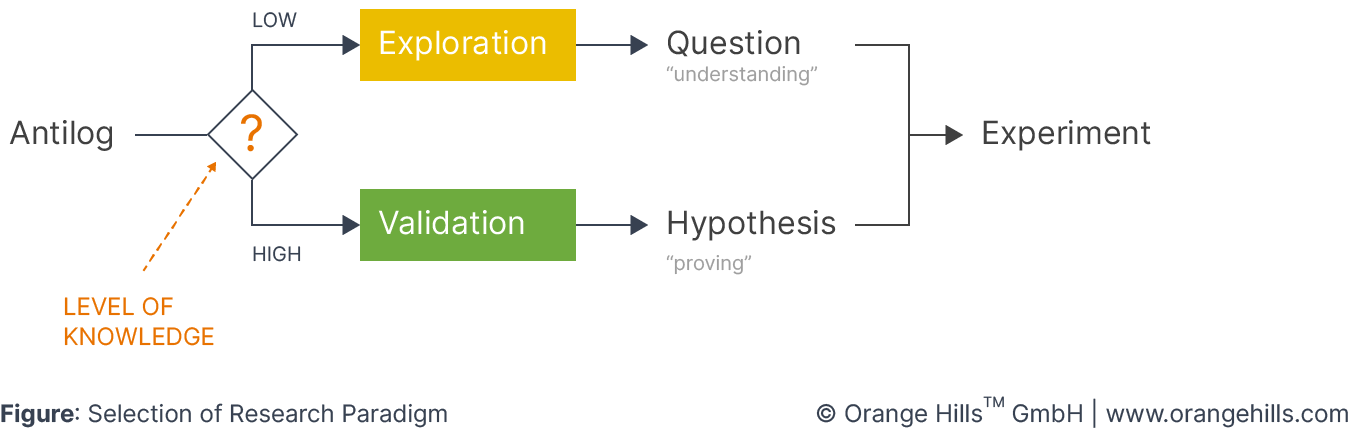
The research tools and methods you use for exploration are similar to those in Step 2: Discover, with one difference: you already know roughly what your business model looks like, but some parts of it still need further exploration. This means you can include a prototype in all your experiments, to make your offering tangible and generate more detailed insights. For example: you discuss with experts using a process prototype to collect the information you need, or you schedule customer interviews and capture their reactions to your UI prototype. Plan these experiments wisely. Here are some examples:
Open Question | Experiment | Prototype (Example) |
"Are the functions our software should provide the right ones?" | Customer interview We discuss possible functions with our customers and capture their reactions to our prototype. | Click dummy We prepare a click dummy that shows the functions we plan to include. |
"Are the marketing channels we're considering the most promising ones for our offering and sales funnel?" | Expert interview We talk to our marketing team (or other marketing specialists), discuss our selected channels and get feedback. | Pitch deck We prepare a pitch deck for our offering to support the expert interview with marketing specialists. |
"Is our selected sales partner capable of taking care of our end customers' individual needs and supporting them when issues arise?" | Expert interview We discuss our sales & service journey with our selected sales partner and adapt it together. | Process prototype We prepare a prototype that visualises the sales & service journey. |
Keep in mind
At the beginning, you'll have a lot of open questions — not all of them are relevant for Step 4: Validate. Questions about what your business model or product should look like need to be answered in Step 3: Design. For example: "What is the best approach to sell our offerings?" is a question for design, not validation. Another example: "Is our LinkedIn marketing channel effective and efficient enough to reach our prospective customers?" This question is still fairly broad, but it fits the idea of Step 4: Validate.
2. Duration
5 weeks (see Step 4: Validate)
3. Key Activities
The following activities represent the core of exploring open questions:
Design experiment: First, look at your open question and redefine or refine it if needed. Then choose a method or tool to answer it (see Tools & Methods for Phase IV for inspiration) — for example, an interview with a prototype, an expert discussion or desk research.
Prepare experiment: Once you've chosen your method and tools, start preparing: you'll often begin by developing a prototype to support your experiments. You also draft a guideline for your customer or expert interviews, and schedule appointments.
Run experiment and analyse results: Experiments that explore open questions usually produce qualitative insights. Collect and analyse them to draw out implications for your business model, and integrate your findings into your business model and prototypes right away, so you're ready for validation.
4. Participants
Optional: Prototyping Expert
Optional: Research Expert
(Potential) Customers
5. Tools & Materials
See Tools & Methods for Phase IV for an overview
6. Instructions for Coaches
Discuss with your team the difference between exploring open questions and validating hypotheses, based on your research focus. You don't validate anything in exploration mode — the results help you shape your business model, but they won't tell you whether it will succeed in the market. That's what you do when you are Validating Hypotheses.
Make sure your teams include a prototype in their experiments, to gather more detailed insights. Customer interviews or expert talks about the business model or offering shouldn't happen without some kind of visual representation of it.
The level of reality of your experiments in exploration mode is usually quite low. When you're in contact with potential customers — in an interview, for example — you can still ask whether you may come back for a second conversation later in the project, once your offering is ready. Agreeing to a second meeting is only a low level of customer investment, but it's still helpful input once you switch to validation mode.