
Organisational Structure
Inside a business line, across several of them, or in a unit of its own? There is no right answer to where innovation work belongs, only different prices to pay. This article walks through the options, the degrees of independence that come with them and the interfaces that decide whether any of it works.

Bernhard Doll
Business Design Maverick
Content
Every established company runs two businesses at once. One exploits what already works: it optimises, scales and plans, and it is measured on how precisely it hits its numbers. The other explores what might work next: it searches, tests and discards, and for a long while it produces learning rather than revenue. Both are legitimate. They just cannot live under the same rules — and when they do, the known business wins every argument, because its numbers are the more certain ones.
So this article does not look for the best structure. It works through the two questions you answer whenever you draw one: how much independence does innovation work need in order to survive next to the core business, and how much closeness does it need in order to use that business's assets? Every option below is a different answer to those two questions, and each comes with a bill.
1. Where Innovation Work Sits
There are many options to define a suitable structure for initiating and managing innovation activities. Which structure is the right one depends on the type of innovation you are aiming for. Innovation activities can be organised within business lines (see figure, 1.), across business lines (2.) and in a dedicated and centralised organisational unit (3.) - internal or external. This unit can have its own P&L responsibility or act as a pure cost centre.
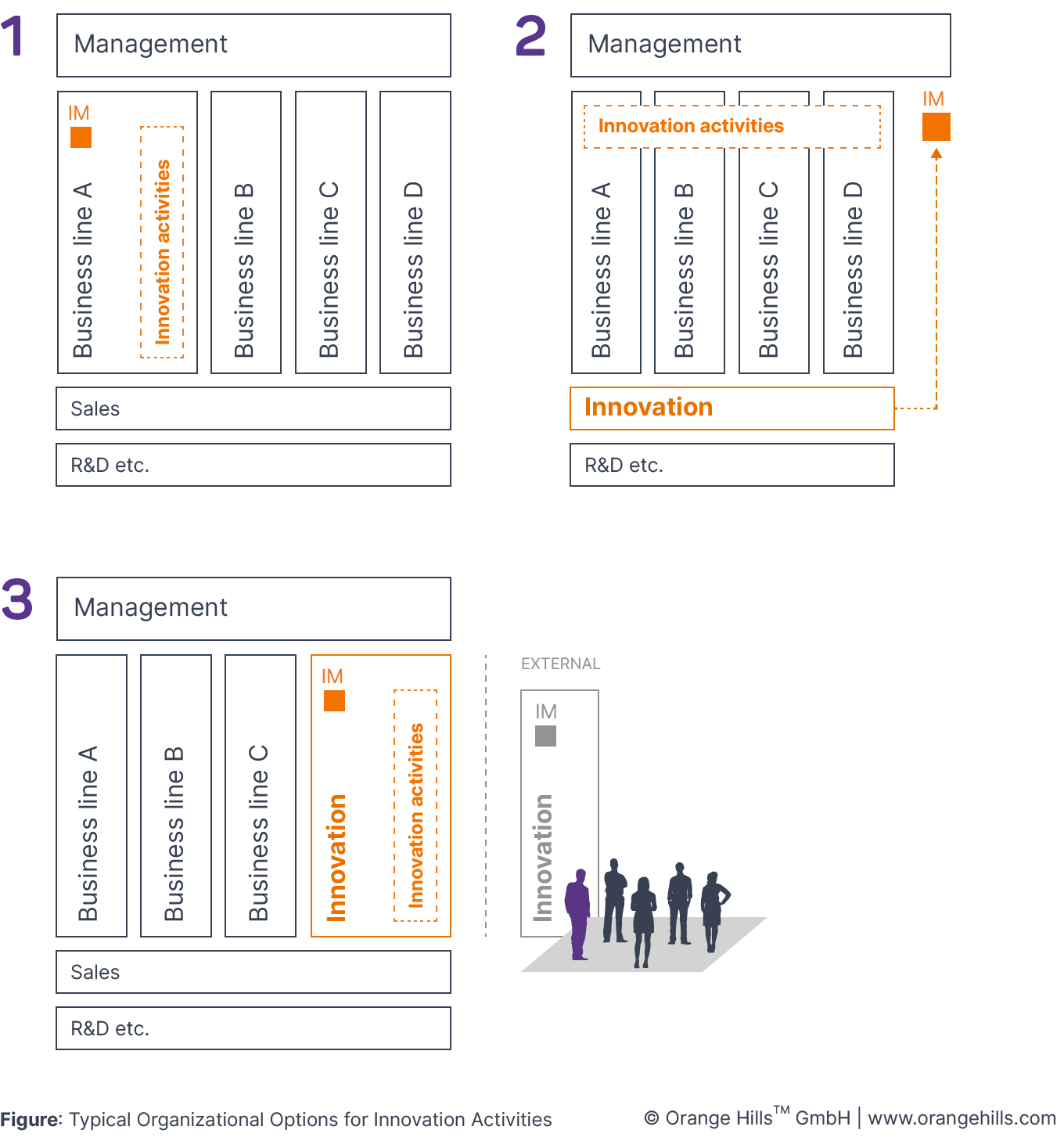
Well, there is no natural law that says which organisational structure fits best to design what type of innovation. However, building such systems in real life has taught us the following:
Option | Type of innovation | What it costs you |
1 | Best fit to design incremental innovation (H1) for a business line | The line's own priorities win. When the quarter gets tight, the project loses its people first — and anything that threatens the current business never makes it onto the list. |
2 | Best fit to design new business potential (H2) for existing customers the company knows quite well | Ownership. No single P&L carries the result, so budget and people are negotiated every time — and the receiving unit has to be named long before the handover. |
3 |
|
|
2. Internalised or Externalised Innovation
This is a different question from option 3 above: not where the unit sits on the org chart, but who staffs the team. An important stream worth mentioning here is externalised / "outsourced" innovation management through independent project teams, acquisition or partnering with start-ups and other partners. This approach usually works in parallel to internal activities, but needs clearly defined touch points with the organisation. With Business Design we focus predominantly on both internal and external innovation processes and love to explore the best setup for specific innovation tasks.
Internalised innovation:
Project teams are staffed with internal employees who invest dedicated time and effort into projects and activities. The benefit of this setup is simplified access to the organisation's resources. But it is also worth mentioning that really new ideas won't grow necessarily out of a legacy culture. Existing power and work structures and a culture tailored around continued optimisation rather than exploration are rarely a hotbed for innovation.Externalised innovation:
Project teams are situated "outside" of a company and are staffed with internal and / or external experts that establish their own independent structures to create new ideas. Independence cuts both ways here. The team is not slowed down by bureaucratic processes — and it often struggles to get the resources of the mothership it actually needs, above all access to the customer base.
A dedicated unit usually needs both. A small permanent core holds the method, the network and the memory; rotating members bring the domain knowledge of the business line the result will land in — and take the experience back with them. A unit staffed only with permanent innovators loses touch with the business it is innovating for. One staffed only with rotating people starts every project from zero. Two or three permanent people are normally enough to keep the method alive.
3. How Much Independence?
"Independent" is not one switch. It is at least five, and you set each of them separately. Most structures that disappoint were set free on the org chart and left tied everywhere that mattered.
Budget: Does the team hold money of its own for the year, or does it apply for it project by project in the core business's budget round? A team whose budget is reopened every quarter spends its energy defending the work instead of doing it. Governance describes how the innovation budget is set and ring-fenced.
People: Is the Project Team released from its line duties for the duration, or does it contribute on top of a full job? Part-time innovation is the most reliable way to produce part-time results.
Decision rights: Who may stop a project, change its direction or walk into a customer's office? Governance sets out who decides what. The structure decides where that person sits — inside the affected business line or outside it.
Targets and measures: Is the team measured on revenue and margin from month one, or on what it has validated until the business model stands? See Measurement of Success & Progress.
Processes and tools: Does the team run on the core's purchasing, IT and approval processes, or on lighter ones of its own? A two-week experiment cannot wait six weeks for a new supplier to be onboarded.
Every notch of independence you grant costs access. Distance buys speed, and it protects an idea that would look unprofitable next to a running business. It also cuts the team off from the assets that made the idea worth pursuing in the first place: the customer base, the brand, the sales force, the production line, the data. That access is the unfair advantage a corporate team has over a real start-up. Spend it deliberately, not by accident.
Two questions usually settle the case. First: how much of the new business rests on assets of the core business? The more it does, the closer it has to sit. Second: how much does the new business threaten the current one? The more it does, the more distance it needs, because no business line funds its own cannibalisation for long.
Let's say a machine manufacturer wants to sell machine availability instead of machines. The new offering needs the same service technicians, the same spare-parts logistics and the same customers — and it makes the old pricing model look obsolete. High dependence and high threat at the same time. That is the case for option 2 or 3: a team that reports outside the affected business line, but holds a written claim on its service resources.
Keep in mind
An innovation unit without a mandate is an expensive suggestion box. Before you draw a box on the org chart, write down what it may decide alone: budget up to which amount, which projects it may stop, which customers it may approach without asking. A unit that has to ask for all three has been given a name, not a structure.
4. The Interfaces Decide
Whichever box you draw, the work crosses the line to the core business several times, and every crossing is a place where it can quietly die. Four interfaces are worth defining before the first project starts.
Where the topics come from: Innovation activities follow the playgrounds derived from the Picture of the Future, not the preferences of whoever shouts loudest in the management round (see Framing Playgrounds).
Who supplies expertise and data: The specialist departments are partners and suppliers to the project team, not its owners. Their contribution has to be planned like any other resource — agreed with their line manager, in days, with names on it. Goodwill is not a resource plan.
Who takes the result: A validated business still has to land in an operating unit. Name that unit while the project runs, and make sure the Project Sponsor sits where the business will land. In Phase V this becomes visible to everyone — and by then it is far too late to start the conversation.
Who pays for what: A unit with its own P&L pays internal transfer prices for everything it draws from the core: sales time, service technicians, the data platform. A cost centre does not. Write the rule into the System Playbook before the first project, because the argument about who pays always arrives, usually in month four.
None of these four is a structure question on paper. All four become one the moment the first project runs.
Keep in mind
Name the receiving unit before the sprint's D-Day, and put its head in the room when the decision is taken. A business handed to a unit that first hears about it at the handover meeting will be handed straight back — politely, and with excellent reasons.
5. Signs Your Structure Is Wrong
Nobody reorganises because a diagram looks wrong. You reorganise because the same things keep happening. The symptoms below are worth reading as structural rather than personal — each one points back at one of the five dimensions above.
What you observe | What it usually means |
Projects take ages | It might be the case that the people involved are neither trained for innovation work nor incentivised accordingly. Training experts or setting up a team / unit of innovation professionals could be a solution. |
The team is complete on the org chart and never complete in the room | People were assigned, not released. Ask their line manager what they think they agreed to. |
Every decision goes one level higher than the last one | Decision rights were never written down, or the mandate is one nobody believes. Governance has the table; the structure decides who sits in it. |
The unit produces prototypes, presentations and goodwill — but no business | Nothing was ever handed over, because no receiving unit was named while the project ran. There may also be a different definition of Leadership across the company. |
Ideas that would hurt the current business never reach the Portfolio | The work sits inside the business line it threatens. That is option 1 doing exactly what option 1 does. |
The team keeps asking the core business for data and keeps waiting | The interface was agreed as goodwill instead of as days with names on them. Too much dependence between two units. |
Nobody outside the unit can say what the unit is for | Not a problem a box on the org chart will fix. Go back to the Picture of the Future. |
One of these on its own is a bad quarter. Three at once is a structure that was never given what it needs.
6. Structures Change
The three options are not a menu you order from once. Most organisations move through them, and every move has a typical trigger and a typical failure.
The usual path starts inside a business line: one project, one sponsor, a team with real days. It works because it is small and because the line can see what it is getting. The limit shows up the moment an idea is worth more to the company than to the line that happens to host it.
From the line to the cross-line team. The trigger is an idea with several owners, or none. The failure is to build it as a committee — a representative from every affected line, each with a veto and none with the time. Name one team with days, and give the other lines a supplier role rather than a seat.
From the cross-line team to a unit of its own. The trigger is the third or fourth project running in parallel, with the same people negotiating the same resources every time. The failure is to create the unit and leave the mandate behind in the lines. A unit that still has to ask for everything it had to ask for before has changed its address, not its structure.
From the unit back into the business. This is the move nobody plans and most organisations eventually make. A validated business leaves for an operating unit, and sometimes the unit itself dissolves once the core has learned to do the work. Neither is a failure. An innovation unit doing the same job in the same way after eight years is either very good or it has quietly become another department.
Whichever move is due, it follows the work rather than announcing it. The Roadmap for Implementation sets out how to sequence changes to the organisational context so the organisation does not have to swallow them all at once.
7. Q & A
Do we have to reorganise before we can start with Business Design? No — and you shouldn't. Start with one project inside the structure you have: a sponsor who can decide, a team with real time and a business unit that would take the result. Structure follows evidence. After two or three projects you will know which constraint actually hurt — budget, people or decision rights — and you can fix that one instead of redrawing the org chart on a hunch. The Roadmap for Implementation sets out the sequence. What you cannot skip is the mandate: a pilot without one produces a result nobody is allowed to act on.
Should we build an innovation lab? A lab is a room. Whether it is also a structure depends on the five dimensions above. If the honest answers are "no budget of its own, people on top of their day job, no decision rights", you have bought furniture. Those labs produce prototypes that never reach a market, and when they get closed two years later, innovation takes the blame rather than the setup. Decide the mandate first, then the address.
Our innovation unit is a cost centre, not a P&L. Does that matter? Hardly at all for the work, and a great deal for what comes after it. A cost centre can explore, validate and hand over perfectly well, and it avoids being measured on revenue while it is still learning. What it cannot do is own a business in the market: at some point somebody has to carry revenue, cost and risk in one place. Decide which unit that is long before the handover.
Where does the innovation manager sit — at the centre or in the business units? Both, and on purpose. Governance distinguishes centralised and decentralised governance for exactly this reason. The central Innovation Manager holds the rhythm and the cross-unit view of the Portfolio; the decentralised ones own their unit's portfolio and prepare its quarterly review. One person doing both for a large organisation ends up doing neither.